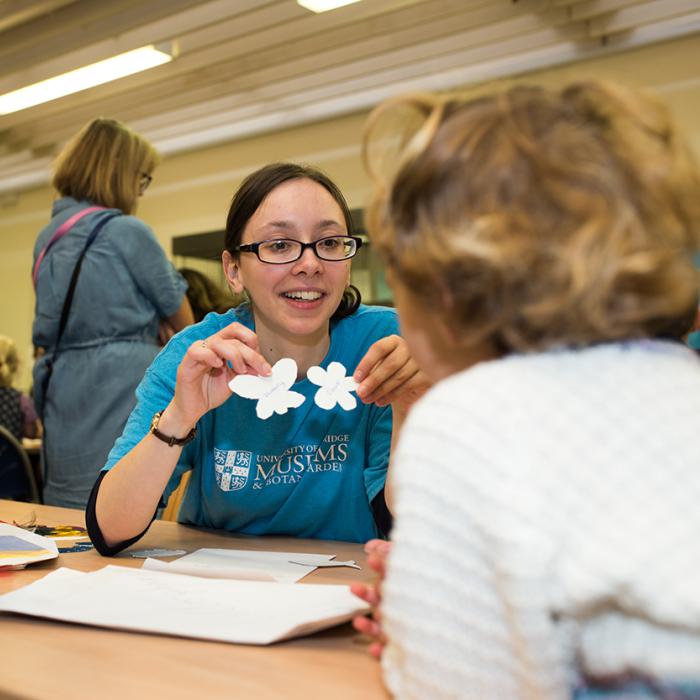
Join us for a relaxed and social session in the galleries with your baby. This sensory, playful session will introduce different ways to explore the gallery with your little one. This session is suitable for 0 – 18months.
Session runs 1-2pm
A family ticket is for up to two adults and three children
Bring your little explorer for a story-based journey through the museum. This relaxed and social session will include sensory, hands-on and playful activities.
Please note, the session will move through different galleries and museum spaces. To allow enough space for all participants, we kindly request buggies not be brought into the galleries during the session. A buggy park will be available at the accessible entrance of the museum. This session is suitable for 18 months – 5 years.
Session runs 10.30-11.30am
Come and explore, play, create and have fun with materials in our Creative Studio on the lower ground floor!
Workshops are free and supported by the Fitz Families team. All materials are included, and the workshops are suitable for children aged 5-12 years with their parents and carers.
This month, create your own three-dimensional soft sculpture using flexible wire, tracing paper and felt. Explore shape, form and transparency as you build and layer materials to create unique sculptural artworks inspired by contemporary ceramics and 3D sculpture practices.
Come and make some beautiful artwork using different shaped leaves from the Garden.
Ages 3 +
Children must be accompanied at all times.
Free child tickets for this event must be booked online. Ticket sales open one week before the event. Adults do not need to book to accompany however please note that adults will be required to pay for Garden entry on arrival.
Join us for Little Stars, a relaxed morning at the Whipple Museum. We’ll have picture books, drawing materials, and sensory play resources. We’d also love to hear what you’d like to see in future activities for little ones at the museum.
There’s no need to book, just drop-in. All welcome, especially suitable for families with babies and young children.
Join us for Little Stars, a relaxed morning at the Whipple Museum. We’ll have picture books, drawing materials, and sensory play resources. We’d also love to hear what you’d like to see in future activities for little ones at the museum.
There’s no need to book, just drop-in. All welcome, especially suitable for families with babies and young children.
Exactly 120 years ago, Hertha Ayrton was awarded the Royal Society’s prestigious Hughes Medal, the first and only woman in the entire twentieth century to receive this honour.
A close friend of Marie Curie, Ayrton was an electrical engineer, mathematician, physicist and inventor, as well as an active suffrage campaigner. While a student at Cambridge’s Girton College, she also founded the College’s own Fire Brigade.
There will be a chance to use our bat detectors, find out about what bats eat and where they live.
£7 per person (adults & children). Booking essential and will open in early August.
This walk is strictly for over 8’s and children must be accompanied at all times. When booking please be aware that each member of the group will need their own ticket.
This event is weather dependent.
Celebrate the magic of butterflies and moths. We will be looking into their life cycles and finding out some fun facts about the ones that visit the Garden.
Ages 3 +
Children must be accompanied at all times.
Free child tickets for this event must be booked online. Ticket sales open one week before the event. Adults do not need to book to accompany however please note that adults will be required to pay for Garden entry on arrival.
Build yourself a pocket-sized, hand-held ‘brain’ game that can keep you occupied for hours while testing your focus and memory skills!
No electronics experience is required although you will need a steady hand to assemble the components and use our tools.
This is a great workshop aimed at children aged 10 years and above.
This event is part of Summer at the Museums 2026.