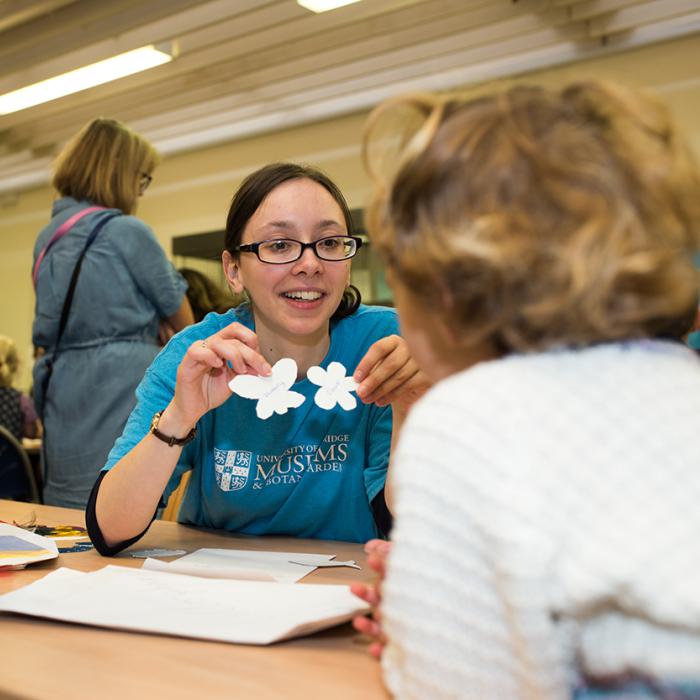
Explore the wildflowers of the Botanic Garden with our early morning guided walks, a special opportunity to experience the Garden before it opens to the public. Each walk highlights seasonal species, from bee orchids in the Old Pinetum to eyebright on the Ecological Mound, offering insight into their identification, ecology and distribution. You’ll also hear about their historical uses and folklore. Join us for one or more sessions and discover the rich diversity of British flora.

Giant deer, fossil fish teeth, the rocks that built Cambridge... just some of the specimens on display that our staff can't wait to discuss with you. Beware, their enthusiasm is infectious!

Drop into our shop to reserve your free place on the tour.


Giant deer, fossil fish teeth, the rocks that built Cambridge... just some of the specimens on display that our staff can't wait to discuss with you. Beware, their enthusiasm is infectious!

Drop into our shop to reserve your free place on the tour.
 

Giant deer, fossil fish teeth, the rocks that built Cambridge... just some of the specimens on display that our staff can't wait to discuss with you. Beware, their enthusiasm is infectious!

Drop into our shop to reserve your free place on the tour.


Giant deer, fossil fish teeth, the rocks that built Cambridge... just some of the specimens on display that our staff can't wait to discuss with you. Beware, their enthusiasm is infectious!

Drop into our shop to reserve your free place on the tour.
 

Join us for a rereading of Carl Linnaeus’s 1732 diary of a trip through Northern Scandinavia. In the summer of 1732, the Swedish medical student Carl Linnaeus (1707–1778) travelled through Northern Scandinavia. His diary of that journey has been celebrated as pioneering modern scientific and ethnographic fieldwork. 

Dr Staffan Müller-Wille proposes to read it against the grain. The knowledge Linnaeus gathered was generated “in transit” at intersections of diverse communities and affected by frameworks of hospitality and hostility.


This lecture brings together historians Zhiyù Chén, Mika Hyman, Daniel Margocsy and Alexander van Dijk from the Department of History and Philosophy at the University of Cambridge to discuss how Chinese, European, Filipino and Indonesian communities pictured, preserved, mapped and discussed the landscapes of Southeast Asia during the period of rapid colonisation and globalisation between 1500-1900. 

We explore the deep influence of cycles and circulations on our planet, our economies, and our everyday lives. Drawing on perspectives from ecology, history, and critical theory, Allen delves into how natural cycles—like the water, carbon, and nutrient cycles—have shaped our understanding of nature, life, and sustainability. These systems are not only crucial for planetary health but also serve as metaphors for how humans interact with the environment.

In the early 1980s, scientists and public health officials from around the world hailed Singapore as a model for the control of dengue fever. Between 1965 and 1985, health authorities dramatically reduced the incidence of dengue by suppressing Aedes aegypti mosquitoes through cleaning campaigns and environmental modification. However, after 1985, annual epidemics of dengue swept through the country despite low mosquito densities, leaving authorities scrambling for answers. 

Mauna Kea is a sacred mountain in Hawaii, yet it is also one of the world’s best locations for astronomy. Since the 1960s, large telescopes have been built on its summit, with the latest and largest, the Thirty Meter Telescope (TMT), sparking intense controversy between Native Hawaiians and the scientific community.

When examining the scientific community’s efforts to include Native Hawaiians in the decision-making process for TMT, we find that many attempts at inclusivity were performative and failed to meaningfully represent Native interests.

Subscribe to Adults (18+)