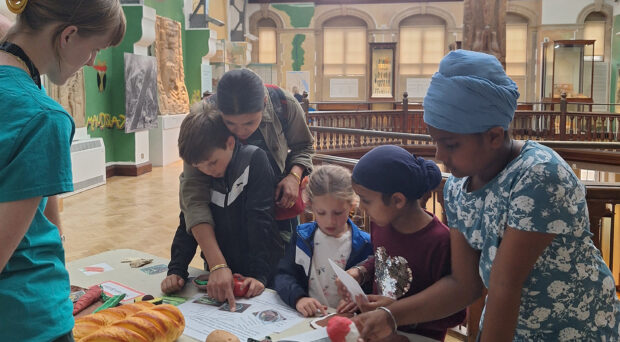
In Autumn 2025, the Arthur Rank Hospice invited the Museum of Archaeology and Anthropology (MAA) to deliver a six-week programme of object-handling sessions for outpatients.
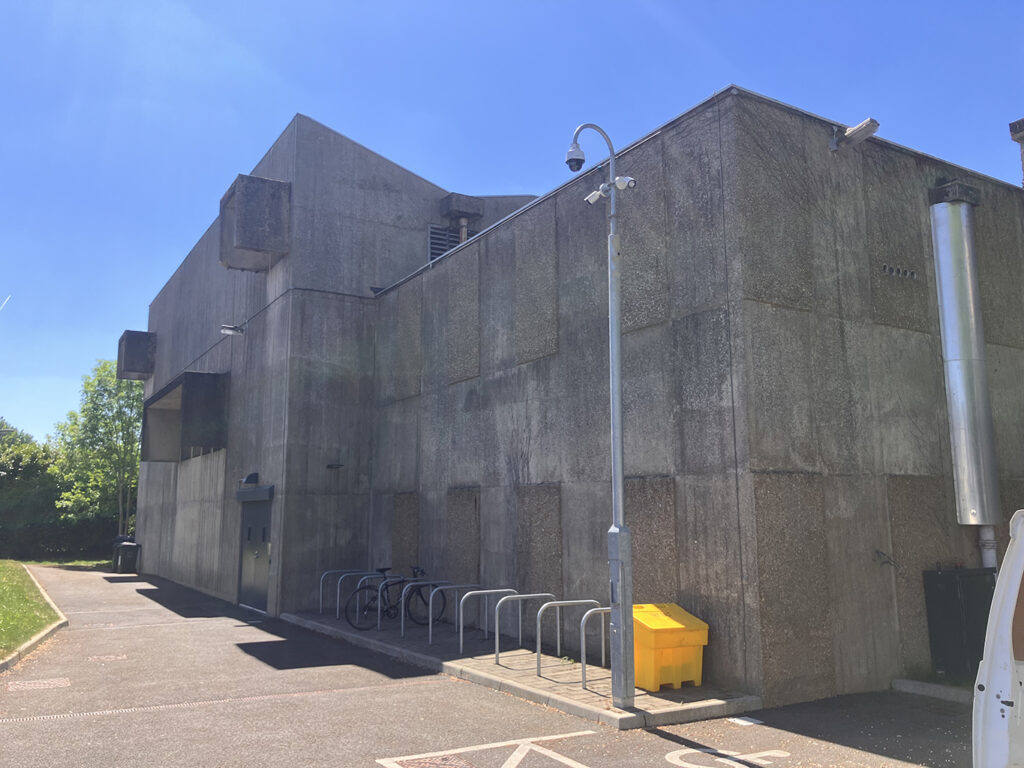
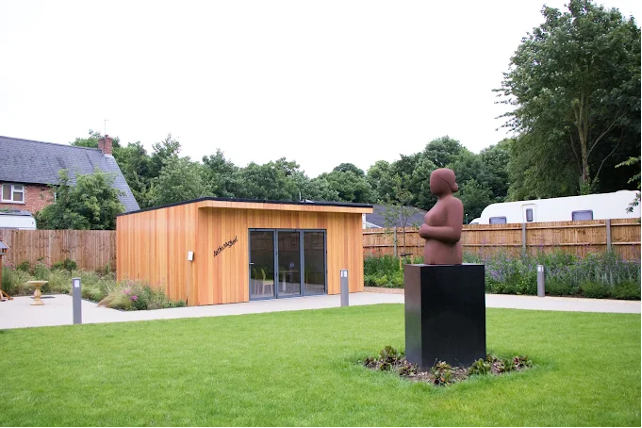
Sarah Talks and Rosie Croysdale from the MAA Education Team worked alongside Sophie Wakefield, Art Therapist and Life Celebration Coordinator at Arthur Rank Hospice Charity (ARHC). The sessions took place at Arthur’s Shed, a multipurpose studio and community space set in the beautiful hospice gardens.
Where it all started
Our connection began in July 2025 when we received an email from Sophie inviting us to deliver an online talk about the collections as part of the Hospice’s Living Well service.
This holistic service offers specialist advice and support to outpatients, including tailored individual programmes with a wellbeing focus. Healthcare professionals refer patients to various activities and social groups to support their wellbeing. This includes those experiencing life-limiting conditions or receiving end-of-life care.
Our presentation involved a ‘virtual unboxing’ of Anglo-Saxon finds from the Little Shelford area, from MAA’s Centre for Material Culture (CMC). Sarah and I thoroughly enjoyed connecting with the patients, whose generational and anecdotal knowledge of the area in response to the excavated finds and mapping of Shelford sparked an animated conversation about the rapidly transforming Cambridgeshire landscape and our place in it today.
The popularity of this online session and the feedback we received, made it clear that for the patients, sharing and discussing meaningful objects with others fostered connection, storytelling and moments of closeness, which was particularly comforting for patients living independently, and at greater risk of isolation. This prompted the expanded, in-person programme.
How did the programme run?
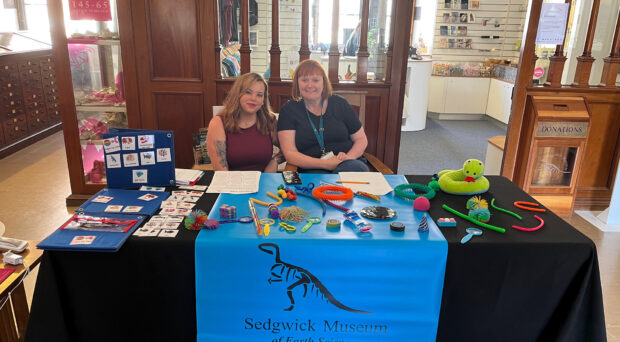
Every Thursday afternoon from early October to mid-November, we travelled Arthur’s Shed with objects from the handling collection. These objects responded to specific topics, themes and guiding questions from Sophie.
Each week, we welcomed the same group of five participants to explore these objects, engage with the broader questions and, with Sophie’s guidance, respond creatively to the ideas, thoughts and reflections that had been shared to the group using mixed media (clay, pens, paper, watercolour).
Arthur’s Shed became a safe space for personal reflection and open exchange, an environment in which the relational value of objects in the handling collection, their ability to forge connections between members of the group and their overlapping lived experience, became truly visible.
We linked our first session with the group to the theme of memory. For their symbolic association with cultural memory, personal identity and afterlife resemblance, we brought an Ancient Egyptian faience shabti – a small figure entrusted to carry out work on behalf of an individual in the afterlife.
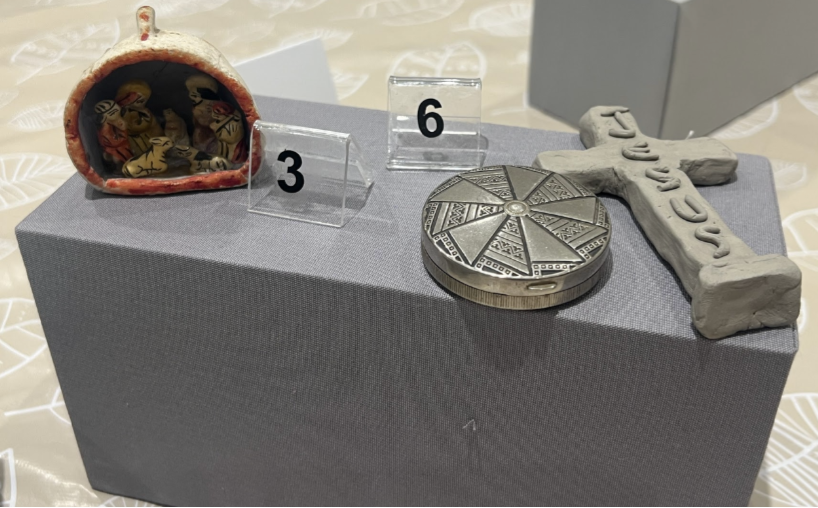
We also brought a small collection of silver milagros (votive offerings) from Mexico, used as healing charms, treasured for their ability to conjure memories of loved ones and past experiences, but also as a channel for prayer.
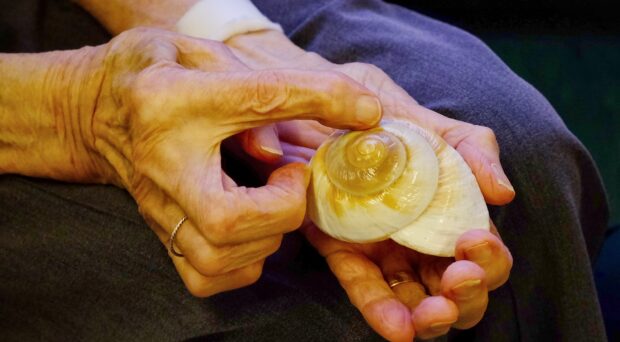
We began by passing the objects around the table and inviting everyone to handle them, to explore and ask questions about their manufacture, materiality and use. They needed almost no introduction. Participants instinctively connected with pieces that mirrored, in some way, the challenges they faced in their own lives.
The shabti prompted a rich and, at times frank discussion about planning for end-of-life and having conversations with loved ones about what to expect. What, we discussed, does it mean to be remembered and how would we like others to remember us? Who, or what, helps us to mark our memories?
Resistance and reflection
We were prepared for the group to respond positively to handling the objects and, in most cases, this was what happened. However, what we were less prepared for was a resistance to handling them. One of the participants stepped back from the milagros, saying it felt too heavy to handle objects into which people had poured their deepest hopes and prayers. We wondered if this ‘heaviness’ was a communication of cultural and emotional weight. Votives index our hopes, dreams and aspirations, but can also become vivid reminders of prayers left ‘unanswered’.
At first, Sarah and I were apprehensive that the session and objects we had planned might be unsuitable. However, it transpired that the decision not to touch became the focus of the session itself – an opportunity for her and the group to investigate the visceral effect that objects can have. The milagros prompted her to reflect on her experience of discovering her faith and coming to terms with chronic illness.
In this case, being confronted with an object she felt she couldn’t touch motivated her creatively. She used the following creative making activity to produce something she could safely and meaningfully hold in her palms: a clay cross with ‘Jesus’ written across the front.
Facing challenges
On the topic of Challenges in Week 3, we brought a Medieval waster jug – a ceramic vessel that has visibly shattered in the kiln. This jug, with a gaping hole in the bottom, has never been functional in the way you would expect a jug to be. And yet, it has survived with its body entirely intact, likely because at some stage, someone somewhere deemed it ‘worth keeping’.
Perhaps, we pondered as a group, a potter kept it as a reminder of a milestone achieved, or of what not to do again in future? Maybe it held sentimental value or beauty to its maker, which we were not privy to as outsiders? Despite having ‘failed’ in the process of becoming a jug, we admired the challenge of making it in the first place; the combination of material knowledge, physical strength and practiced skill.
What, Sophie posed to the group, are some of the struggles we have faced or are facing? When and how might we learn to live with things beyond our control? When has a challenge transformed into something positive?
Connecting as a group
As the weeks progressed, we were pleasantly surprised when participants voluntarily brought in objects to share with the group. One participant brought along a wooden door lock he had purchased from a market in Yemen in the 1960s. I took this opportunity to show him pictures of a similar lock from Tarim, Hadhramaut in the MAA collection. This opened up a discussion about collecting and the difference between the domestic and museum stores.
Another group member brought in an old painting to donate to Arthur’s Shed from his attic. He joked with the group: “To be honest, I just couldn’t stand to live with this piece of junk anymore!”
Meeting regularly each week fostered trust and familiarity within the group. Ensuring the same staff members were present was integral to the planning and directly influenced how openly individuals felt they could share.
This continuity allowed shared experiences and personal backgrounds to connect across each week: discussions about the inheritance (and burden) of ‘stuff’ at home and how the passing of a loved one becomes visible in the accumulation of static ‘things’ lying around at home; the unfinished tasks once attended to as persistent markers of grief. To these reflections, Sophie’s expertise in effortlessly providing guidance to the group was invaluable.
What did we find out?
Overall, it became clear that for some, the commitment to attending these sessions provided a welcome distraction from the emotional weight that chronic illness can bring. For others, it was an opportunity to directly engage with it:
- “I’m experiencing a lot of pain at the moment… These sessions have been really important to me. Just recently, the only time I’m not thinking about my pain is when I’m asleep and when I’m here with you all.”
- “I look forward to coming here every week. To see these objects, but also for chance to get out and away from the house, it’s becoming a real problem… this has been really necessary”.
- “I wasn’t sure what to expect at first when she [Sophie] called me, but I’ll try anything once, I thought, and now I’m here and I am so pleasantly surprised.”
The reactions and reflections that the participants brought to the group allowed Sophie to develop a clearer understanding of their physical and mental wellbeing, and to follow up on any additional support they might benefit from at the hospice.
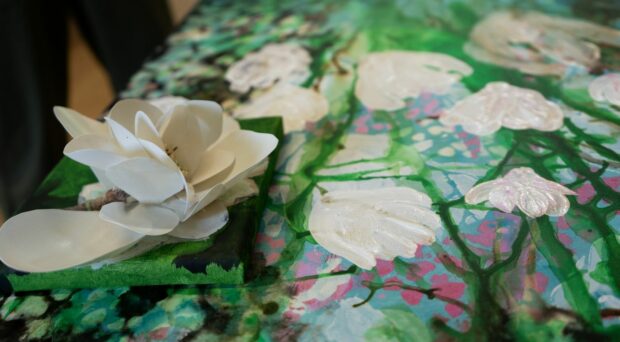
In the final session, we celebrated our time together by building an exhibition of objects – a combination of artworks produced during the making sessions and personal items brought in to share.
What’s next?
Objects possess a unique capacity to surface emotional processes; whatever challenges, achievements, or feelings participants bring into the room can emerge naturally in the process of engaging with and handling collections. Working with objects as a group and attending to their tactile qualities creates space for memory recall, reflection and shared interpretation.
Throughout our sessions, we were struck by the depth of patience and empathy that developed among participants. Over six weeks, a collaborative support network formed, characterised by mutual encouragement, attentive listening and a collective willingness to make meaning together.
We are very much looking forward to continuing this programme with Sophie and the patients at Arthur Rank Hospice in March 2026.
Explore the MAA Digital Lab for more stories about object histories, relationships, and creating forms of engagement that extend beyond the physical space of the museum: www.maadigitallab.org
Read about other museum projects with the Arthur Rank Hospice.