From February 2026, Royal Holloway PhD student Adrianna Chmielewska had the opportunity to carry out her second year placement at the Fitzwilliam Museum. This blog showcases a couple of highlights which reflect the sheer variety of the Museum’s Music collection.
What fascinates me about them is that, like many historical objects, they leave us with as many questions as answers.
Hosted by Dr Suzanne Reynolds, Senior Curator of Manuscripts and Rare Books at the Fitzwilliam Museum, I worked on two projects during the six-week placement.
Firstly, a survey of the Museum’s music collection for prints, ephemera and other distinctive features; and secondly, creating a catalogue record for Sophia Plowden’s Book of Songs (MS 380, Lucknow, 1787-8).
Compositions by Maria Rosa Coccia (1775-1776) (MU.MS.15 and 16)
Early on in my project, I encountered two volumes of music with an identical printed portrait of their author. Surrounded by a frame decorated with ribbons, musical instruments and cherubs is a side portrait of a young, elegant woman. Below the portrait, there are three lines of texts in Latin. These read: “Maria Rosa Coccia Roman, born 4 June 1759. Master of Arts properly registered, at the Philharmonic Academy of Bologna.”
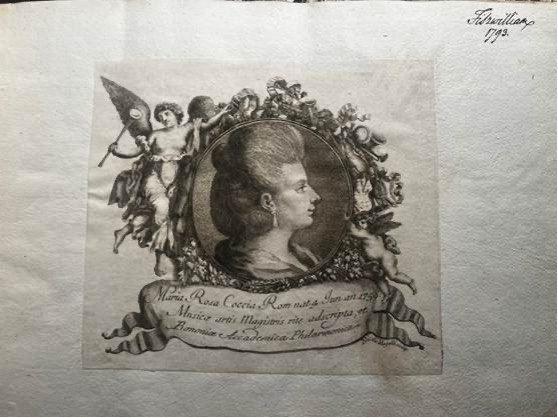
The items contain choral music compositions by Coccia, ‘Dixit Dominus’ (for eight voices and organ) and ‘Magnificat’ (in four parts). Maria Rosa Coccia was the first woman to pass the exam to join the Congregazione di Santa Cecilia and become a professional composer in Rome. She achieved this at just 15 years old.
MU.MS.16 marks Coccia’s trailblazing achievement. Attached to the third folio is a printed leaf of Coccia’s examination composition. This is a fugue on the antiphon ‘Hic vir despiciens mundum’, with examiners’ approval underneath.
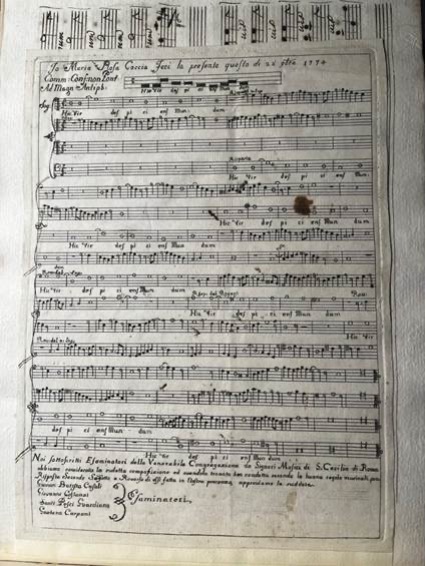
Despite her extraordinary talents, Coccia faced suspicions and attacks from the musical community. Francesco Capalti spread rumours regarding her admittance to Santa Cecilia. Still, Coccia had support from the likes of Metastasio and Farinelli, whose letters of support are documented in Michele Mallio’s 1780 biography.
The volumes are also significant as the first manuscripts I encountered which contained printed ephemera. They can also be found in publications produced in Coccia’s lifetime. While the examination composition can be found in Esperimento estemporaneo fatto dalla signora Maria Rosa Coccia, a pamphlet with poetry dedicated to Coccia from 1775, the portrait figures in Mallio’s biography.
Comparing the two with MU.MS.15 and 16, I am left wondering if a previous owner of the volumes also owned the publications on Coccia and extracted these pages to decorate the music manuscripts. According to his inscription, Fitzwilliam bought the volumes in 1793, but it is uncertain who owned the volumes before him, except perhaps for the addressee, Carlo Moris.
Therein lies another possibility. Both volumes, although rebound in the 1980s, retain their original paper covers, with title written by hand in the middle of the front cover and four decorative flowers pasted in each corner, front and back. The handwriting, which also occurs throughout the composition, seems to be that of a child, with separated, carefully written letters. Yet the title pages are in a different, more sophisticated hand.
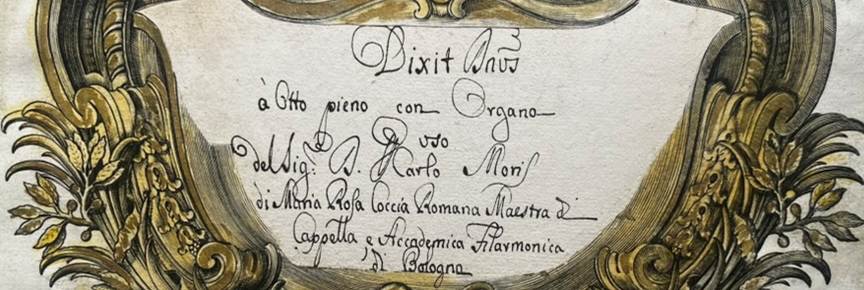
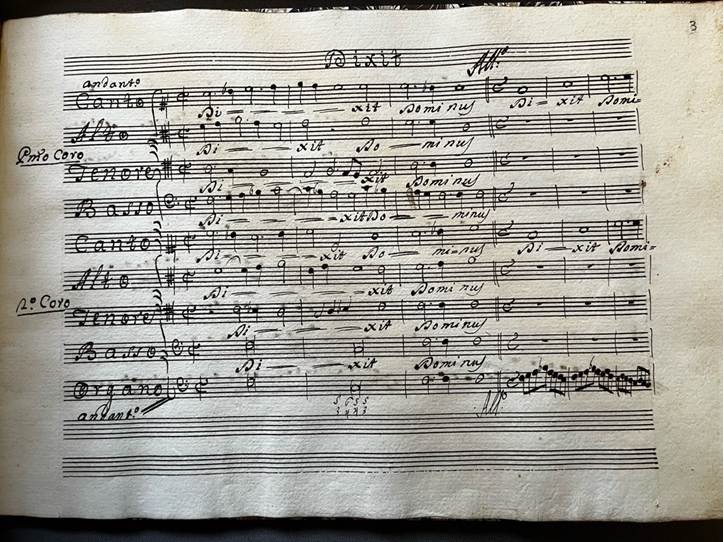
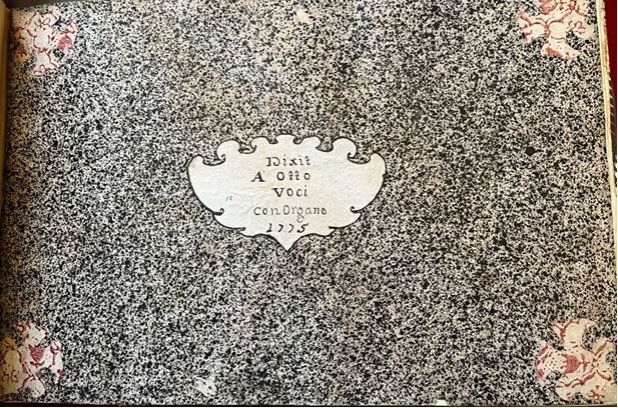
We do not know for sure whether the manuscripts were written by a scribe or Coccia herself. I like to imagine it to be the latter, especially as instrument parts are labelled in the childlike handwriting.
Could it be that Coccia returned to her early compositions and added to them before presenting them to a patron? Or did she receive help from an adult to make her work more visually appealing? If she was the only owner before her dedicatee, did she add the ephemera to highlight her status in the world of music?
The portrait labels her as a Master of the Academy in Bologna, which she did not achieve until 1779. This indicates that the volumes may have been presented to the dedicatee after the composition. Whatever the answer, the presence of the ephemera, the decorative title page and covers emphasise the efforts in promoting and celebrating Coccia’s work and testify to her status as a child prodigy.
Fanny Erskine’s Album, c.1848 (MU.MS.679)
The volume intrigues from the moment it is taken out of its protective box. It has purple velvet covers and the word ‘ALBUM’ striking out in golden letters, framed by golden ornaments.
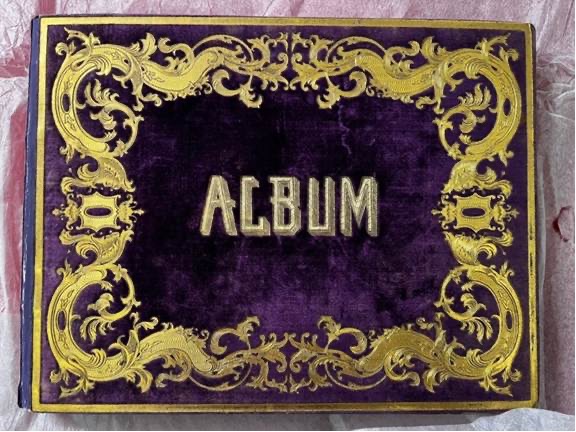
Inside, pages open to reveal a fascinating collection. This includes a pencil sketch by Prince George of Saxe-Meiningen, a visiting card signed by opera singer Jenny Lind, a portrait and poem by August Kestner, an autograph score by Carl Reinthaler, a poem by James Russell Lowell, and an autograph score by Chopin. With it several watercolours, sketches and a miniature golden string instrument originally attached to Lowell’s poem.
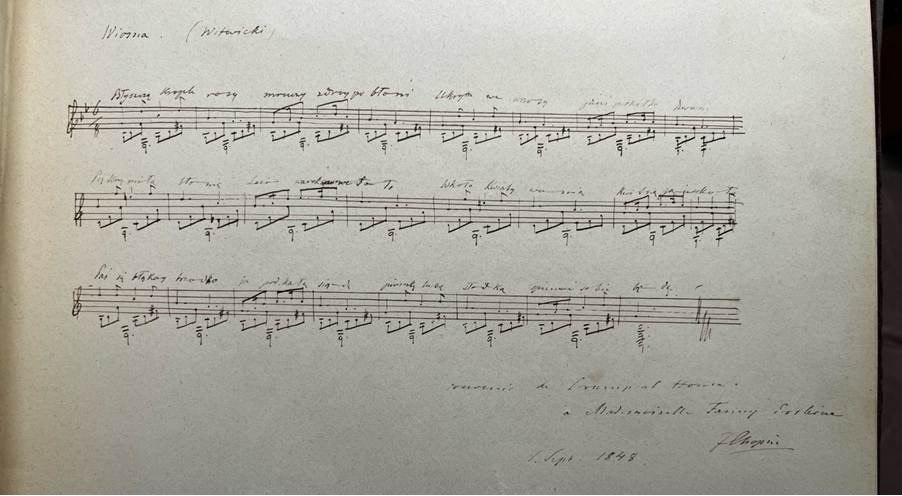
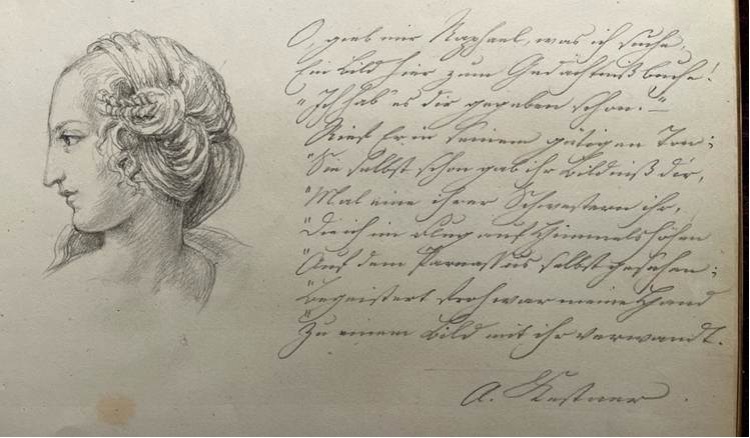
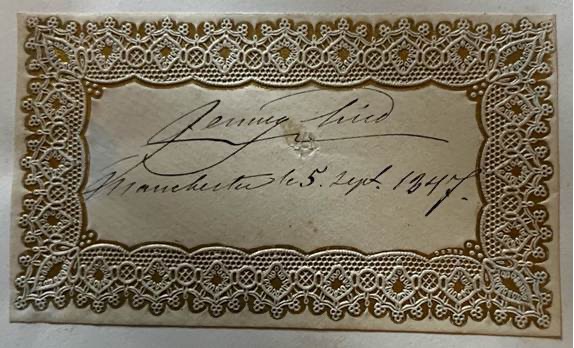
Of the owner, Fanny Erskine, not much is known. Born in 1825 to Scottish orientalist and historian William Erskine and his wife Maitland Mackintosh, Fanny later married Thomas Farrer. They had four children. The eldest daughter, Emma Cecilia Farrer (married to Horace Darwin, son of Charles) donated Fanny’s album to the Museum. The album was compiled when Fanny was not yet married, in her early twenties.
Her diary entries (currently in a private collection) suggest that, between 1847-48, she travelled to Paris with an aunt where she pursued singing lessons and encountered Chopin several times. She met the Polish composer again in 1848 in Manchester, where he penned this autograph.
Yet although our biographical knowledge extends little beyond this, the album is a testament to Fanny’s artistic and social connections. She met with musicians, poets and artists. Some of these meetings were more than fleeting fan encounters, as Chopin’s autograph or portrait by Kestner suggest. Fanny’s family had the means to send her to Paris and endow her with a European cultural education.
Though Fanny clearly appreciated moving in these circles, as suggested by the care with which all the items were kept. I like to think of her as a 19th century fangirl.
Musurgia Universalis, sive Ars magna consoni e dissoni by Athanasius Kircher, 1650 (MU.1359)
This curious volume written entirely in Latin is probably the first encyclopaedia of music. It is divided into ten books, beginning with an exploration of physiology of sound in humans, animals and insects. It moves through various disciplines such as arithmetic, geometry and composition, to then discuss the connection between sound and the spiritual world.
Such a wide-ranging scope of the work is a result of Kircher’s background as a Jesuit priest. His research interests encompassed multiple disciplines. Prior to Musurgia Universalis, he published works on the Coptic language (a group of ancient Egyptian dialects), illumination and projection of images, and physics. He was, notably, the first person in the modern world to describe the Aeolian harp.
All sections are richly accompanied by illustrations which accentuate the level of detail and commitment with which Kircher conceived his work. There are cross-sections of human and frog vocal apparatus, birds with their songs transcribed onto musical lines, a range of musical instruments – existing and proposed by Kircher – and an elaborately decorated portrait of Archduke Leopold Wilhelm of Austria, the dedicatee.
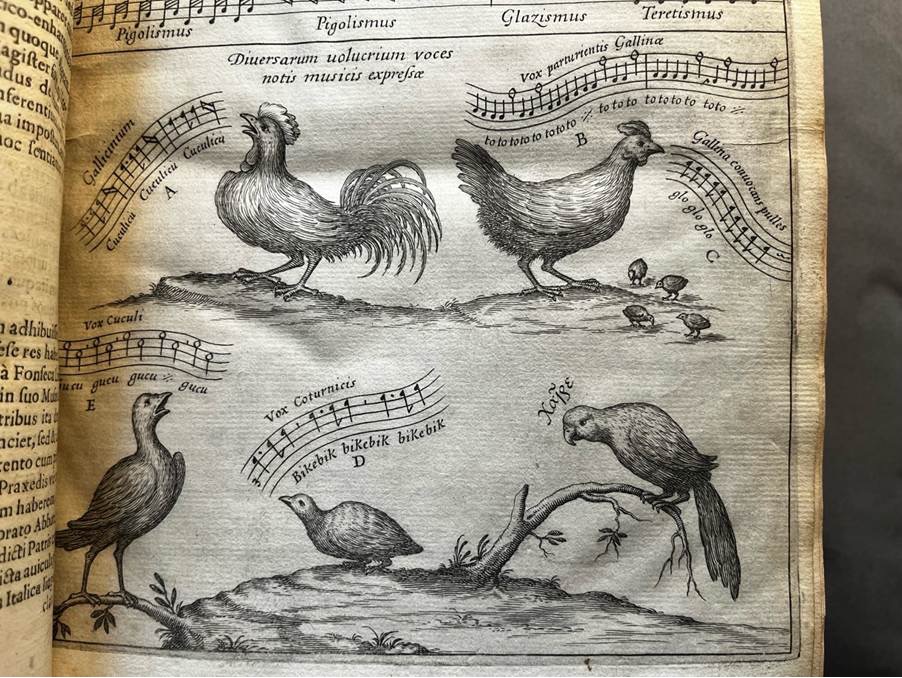
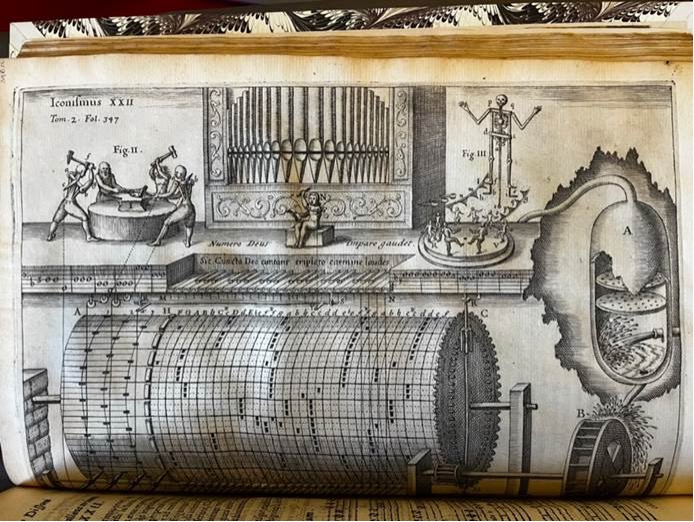
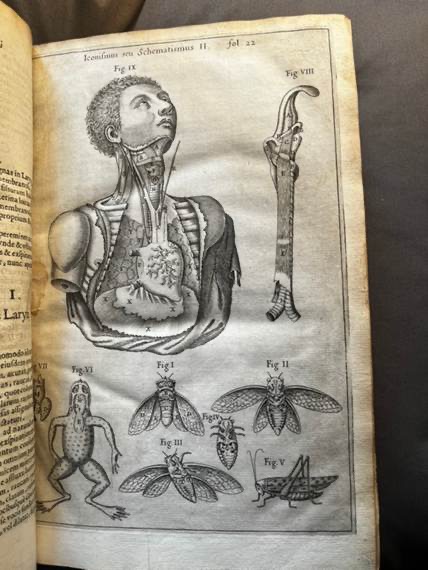
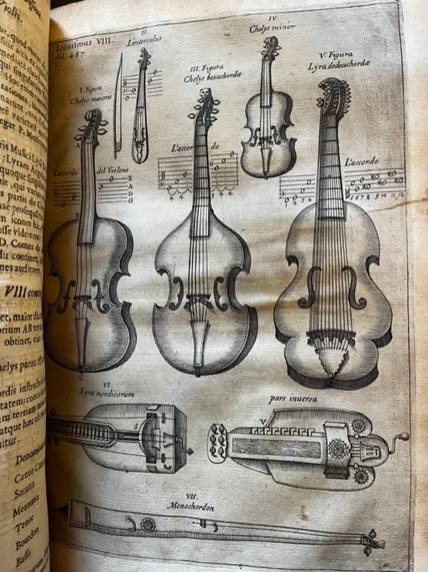
Musurgia Universalis is a significant item in the Museum’s collection not just for its incredible illustrations, but because it represents creativity in the pursuit of knowledge, a persistent feature in the human experience. Kircher’s work also prompts us to appreciate the painstaking effort taken in the past to summarise large volumes of knowledge.
Ticket for a performance of Handel’s Messiah (MU.MS.1443)
It may be one of the smallest items in the music collection, but it is certainly one of the most exciting. It gives a glimpse into 18th century music spectatorship in Cambridge. The ticket, elegantly decorated with Baroque-style curves and illustrations of musical instruments, is for a performance of Handel’s Messiah at the University of Cambridge’s Senate House on 22 May 1760.
Messiah is perhaps Handel’s most famous oratorio, a large-scale vocal performance, usually based on biblical stories. While most of the writing is printed, gaps were left to add the date and title of the oratorio by hand. This leaves one to wonder how, and whether the tickets were mass-printed and reused in later performances in the 1760s. How many of those tickets were printed, to be reused later? How many were sold? Which oratorios were performed?
In the bottom right, we can see the ticket number, 477, pointing to a rather sizeable audience for the venue. This illustrates the enduring popularity of Handel’s works outside of London (it is worth noting that Messiah was first performed in 1741).
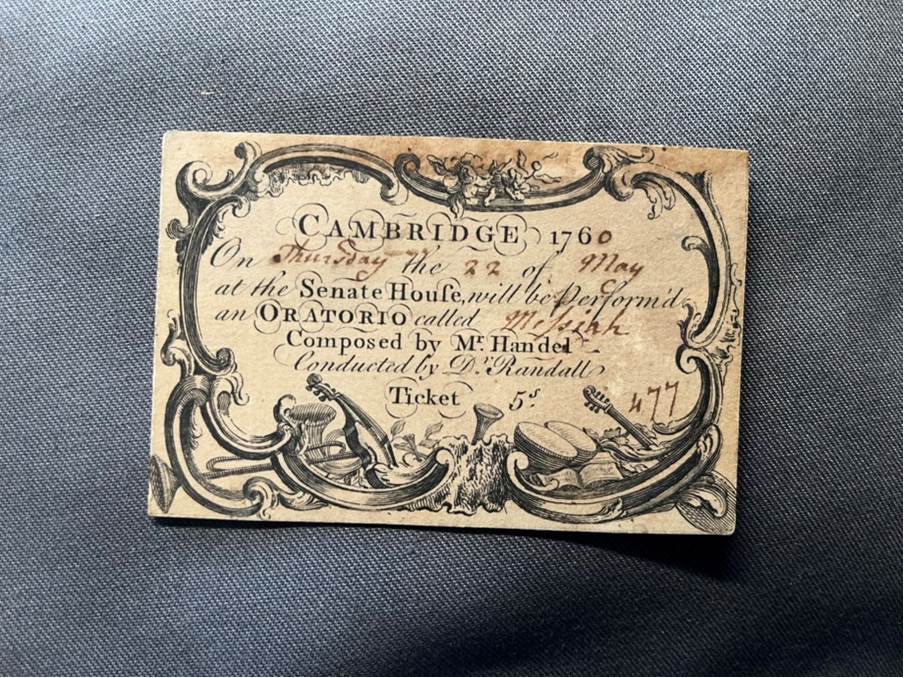
A family connection resurfaces thanks to a note from the donor, Reverend William Davis, which is held with the ticket. Davis was great-grandson of John Randall, who conducted the performance. The ticket itself was found amongst the things belonging to Davis’s mother. Randall was first a chorister at Chapel Royal, then organist and Professor of Music at Cambridge and, as Davis’s note concludes, once a pupil of Handel.
To me, the ticket had a special significance as two weeks before finding it, I attended a performance of Handel’s Acis and Galatea at the Senate House. It became an unexpected symbol of the permanence and persistence of Handel’s work in the cultural world.
Sadly, my ticket looked nowhere near as beautiful.
If you would like to discover more about some of these objects, you can listen to Adrianna’s episode of The Other Kind of Doctor podcast, hosted by the Doctoral School at Royal Holloway